


PAUL MCBETH: Media needs a bit more show than tell
The news industry loves shining the light on things, but could probably use a little more on itself.

Paul McBeth is the editor of The Bottom Line and Curious News, and previously worked at BusinessDesk for 15 years, including two years under NZME ownership and a third year as a contractor. Curious News supplies a daily afternoon market report to the NBR and Good Returns, and this column to Jenny Ruth’s Just the Business.
It’s a natural reaction to raise a sceptical eyebrow when someone impresses upon you that you can trust them.
It’s the sort of thing you expect to hear from a politician on the hustle for votes, a used-car salesman putting the hard sell on, or an insurer promising to stand behind you when you most need it.
It’s also an increasingly over-the-top marketing gimmick for our major media players, who can’t seem to shake the rattled confidence of their audiences.
A little more public soul-searching about the protracted distrust people have in the media wouldn’t go amiss – the responses to the slight improvement in the AUT Journalism, Media and Democracy research centre’s trust in news report didn’t seem overly chastened by the fact that just 37% of respondents couldn’t bring themselves to agree with the statement that they trust news most of the time.
Yes, it’s up from a low point of 32% in 2025, but still well shy of the 53% recorded in 2020. To be fair, 50% of respondents trust the news they peruse themselves, up from 45% last year, reserving their judgement for how other people are getting misinformed.
The feelings disappear
Topping the list of what audiences want to regain their trust in news providers is a desire for transparency and openness, with 94% saying that’s at least somewhat important, followed by 92% wanting to avoid an unreasonable bias in reporting and 93% preferring high journalistic standards.
It doesn’t seem like an unreasonable request, especially given one of the mantras old newshounds try to drill into the youngsters is for them to “show, don’t tell”. An audience is usually smart enough to make up their own minds and won’t necessarily be impressed by a writer’s linguistic gymnastics that can so easily get in the way of a compelling story.
Along those lines, as publishers increasingly adopt the creator economy mindset of encouraging their reporters to develop a personal following, any real or perceived conflicts of interest become more important.
I’ll digress into spruiking the interest register and disclosure policy of The Bottom Line and Curious News, which err on the side of oversharing.
Professional journalists are just that. Their hunt for news tends to push personal interests to the sidelines in their quest to deliver what might be a blockbuster front page lead, or a worthy explanation of a pointy-headed policy problem.
I am still right here
But to expect an audience to take it on faith that they’re simply doing it because they love the job seems like a stretch too far.
As the best leaders discover, trust is earned, not expected.
And for those crowing about the looming death of the mainstream media, sorry, it’ll be a long wait.
Some 61% of respondents still turn to traditional outlets, followed by 33% from other media sources, dropping down to 27% from those social media influencers who focus on news and 23% from other people.
NZME’s The New Zealand Herald is top of the pops, pulling in 52% of respondents as a source of news, with old Granny Herald gaining from 42% the prior year, while Stuff’s stable was unchanged at 51%, TVNZ fell to 50% from 58% and Radio New Zealand nudged up to 35% from 30%.
Beneath the stains of time
And that pans out in readership gains across most of the old classic mastheads in 2025, according to Roy Morgan figures, with the Herald top of the audience food chain across print and digital with 1.78 million in calendar 2025, up 0.8% from a year earlier, and closest rival The Post, and its 353,000 audience, up 0.9% on the prior year.
The South Island mastheads fared a little more poorly, with Dunedin’s Otago Daily Times losing 2.7% of its audience, now at 293,000, while readers of Christchurch’s The Press shrank 5.7% to 266,000.
Cast your mind back to 2020, and the Herald’s audience was 1.88 million, the Dominion Post’s 416,000, The Press pulled in 288,000 readers and the ODT 254,000.
The trend isn’t helpful but is hardly spelling imminent collapse as the doom-mongers among us like to predict.
My empire of dirt
Those legacy mastheads still have a magnetic pull. After Content Ltd sold BusinessDesk to NZME, one of the more frustrating revelations for a small publisher was how little effort the juggernaut needed to drive traffic – and subsequent conversions to subscription – to the site.
For those of us toiling down in the trenches, it can be somewhat discouraging, although mid-tier stalwarts such as The National Business Review and the more recently arrived The Spinoff prove there is an appetite for a commercially viable plurality of news sources.
And let’s be honest. Publishers, broadcasters and advertisers alike can all vouch for the volatility of the media sector, with much of that top-line revenue linked to the appetites of businesses’ marketing budgets.
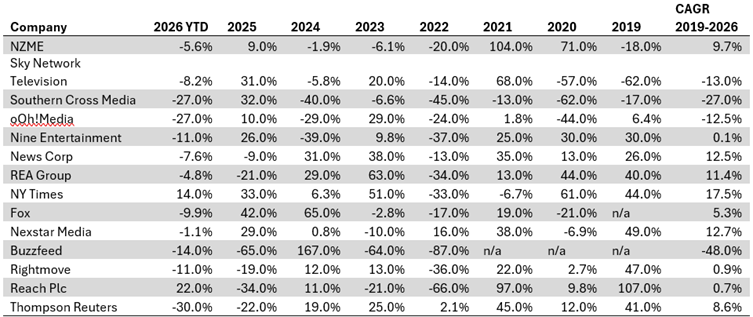
The table below shows just how choppy things can be, with plenty of double-digit annual gains and losses in the adjusted share prices for various listed news and media players since 2019.
If this wasn’t a viable sector, all of those boards would be doing their damnedest to find vanity buyers for their unprofitable operations to preserve the value of their owners’ holdings. The New York Times is anything but failing.
The only thing that’s real
Sure, there might be a bit of variety in the compound annual growth rates of those businesses – and it’s a little underdone in some cases given my CAGR calculator couldn’t cope with treating 2026 as a partial year – but it’s hardly a doomsday scenario across all publishers and broadcasters, excepting perhaps the 2010s internet darling Buzzfeed.
The digital news pioneer was key in driving the online first mentality that gripped newsrooms around the world, with its fast and punchy approach seen as the next big thing.
The problem is that listicles are great for pumping a website full of content that can have ads attached, but doesn’t do much for keeping people up to date with what’s happening in the world – the thing that keeps bringing people back to the tried and true mastheads with a history of delivering.
It would be churlish to say the local majors are sitting idly on their hands, just look at how much better they’ve got at displaying corrections.
But being upfront on potential conflicts, acknowledging that income sources come with potential fishhooks, and just front-footing things in the same way they’d expect from an interview subject go a long way to rebuilding a tarnished reputation.
Ultimately, if they don’t do more to earn their readers’ trust, eventually some curious media type will come along who does.
Image from Adeolu Eletu on Unsplash.
This column has been updated to correct a typo and make clear the table shows adjusted share price movements of those listed media companies.


