


PAUL MCBETH: Rediscovering the relationship between risk and return
The government wants to know what will bring down the cost of capital.

Paul McBeth is the editor of The Bottom Line and Curious News, and previously worked at BusinessDesk for 15 years.
Commerce minister Cameron Brewer was unequivocal in his goal for the long-awaited second tranche of capital markets reform for the coalition government: “It comes down to one thing – the cost of capital.”
He was firmly in retail politician mode after the announcement, describing success as more jobs and faster economic growth flowing from greater access to capital for businesses. But it was pleasing to see decisionmakers alive to the fact that bank lending wasn’t the only way for firms to get ahead.
And the Ministry of Business, Innovation and Employment’s 56-page discussion document better articulated the goals: more proportionate regulations, a strong equity ladder and globally competitive capital markets. That would deliver more efficient access to capital for businesses, provide suitable options for firms at whatever stage of development they’re in and make sure domestic rules don’t stifle the importing of financial products emerging overseas.
They’re all fine goals for addressing what’s become a convoluted regime that’s simply not attractive enough to firms considering how to find the money to do interesting things and employ people.
Never lose it
Of course, what’s good for the goose might not necessarily be good for the gander.
The talk of trading off investor protections against making it easier for businesses to hit them up for money sits uncomfortably when you look at, say, the SpaceX initial public offering in the US – where the space/AI conglomerate got fast-tracked admission to the indices followed by plenty of less-discerning passive investors – or the dozens of people left in limbo while regulators descended on the Du Val and Chance Voight wholesale schemes.
This is often where your correspondent reflects on Simon Power’s reform 15 years ago, when he pointed out that return comes with risk – something the government couldn’t and wouldn’t attempt to legislate away.
The risk-reward equation is actually pretty simple. The greater the chance that something will fail, the bigger return that those putting in money should expect to receive.
The hard part is that the risk – and by extension, return – is a constantly moving feast, and that those wanting to sell investors something aim to do so at the cheapest possible price without scaring away would-be backers of their grand plans.
Never chose this way
Almost two decades of KiwiSaver has substantially improved the financial literacy of generations coming through, but that won’t save them from getting caught up in scams of the 21st century.
And there still seems to be a magic threshold that doesn’t trigger the question of the ever-vigilant – is this too good to be true?
In the 2000s, it was finance companies like Bridgecorp offering a few percentage points more than the prevailing 8% term deposit rate at the time.
In recent years, it’s been a 10% return from property developers’ mortgage funds – an offer that hasn’t budged regardless of whether six-month term deposits were below 1% or hovering around 6%, or if inflation was north of 7% or tucked in the upper end of the Reserve Bank’s 1%-to-3% target band.
Never close your eyes
For all the complaints about those unregulated offers we politely call wholesale deals, they still can’t tell porkies, no matter how sophisticated their potential investors.
But let’s put that into a wider context. Because as the near-70,000 Sharesies users who’ve got a direct investment in Rocket Lab show, people have options.
From supposedly risk-free government bonds to reliable dividend-paying companies and growth stocks, the past six years illustrate how quickly the relationship between risk and return can change.
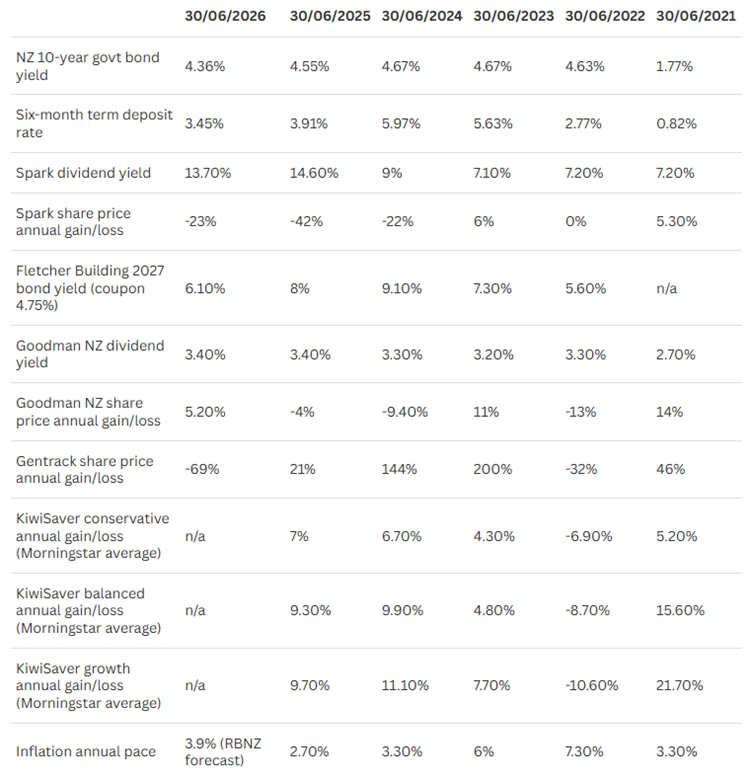
Chart created in Flourish with data from Iress, Stats NZ, RBNZ and MorningStar.
Each individual line tells its own story but as a whole, the table highlights how hard it can be for a regular person to wrap their head around the risk they’re taking on when they’re making an investment.
The once-mighty Spark New Zealand looks like a standout income stock based on the dividend yield of the past few years, but that would be to ignore the vast amount of value destruction its board has presided over in the same period.
Likewise, software firm Gentrack’s boom-and-bust cycle underlines the game of snakes and ladders a pure-play equity growth investment can be, and what happens if circumstances dictate a sale when it’s at a low ebb.
Even the ever-reliable six-month term deposit doesn’t necessarily preserve your capital when the inflation dragon decides to remind governments what happens when they think they can spend their way to prosperity.
And it seems like KiwiSaver largely does what it says on the tin, with returns reflecting the level of risk various managers are taking on behalf of their investors.
Wild boys always shine
At least in those liquid public markets, there’s an army of well-trained traders whose daily button-punching gives the public a better idea of what price they should charge – or pay – when it comes to investment risk-taking.
That remains something of a closed book in the world of private markets and wholesale offerings, where the failure of an apple orchard investment pitching 21% returns apparently caught some eligible investors by surprise.
If there’s a shortcoming in the regime, it lies more in the wider understanding that risk sometimes involves outright failure and that someone’s principal can get wiped out, no matter how long you might wait for things to turn around.
Cutting the cost of capital is key to getting New Zealand’s moribund economy moving, but we won’t get that money to the most productive places if investors, big and small, can’t properly price the risks that they’re taking.
Watch Paul McBeth and Oliver Mander discuss the capital markets reforms:
Image from Nathan Dumlao on Unsplash.


